- » Our Story
- » News
- » Local Contacts
- » Our Work

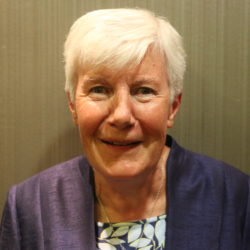
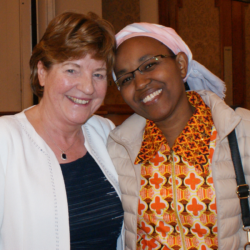
From left - Srs. May McCarron, Maria Ngui, Liz Fletcher (Provincial Leader), Hilary Finnegan, Teresia Njonge
We, the Sisters of Mercy of the Kenyan Province, are presently located in sixteen convents in twelve areas of the country. These houses are scattered over the country mainly running along the Rift Valley from the north-west and spreading out in the south-east. We have also worked during the past twenty years in some six/seven other areas, including the coastal region of the south. The policy has generally been to hand-over and move out of places where we feel that sufficient growth in local autonomy has taken place to effectively continue the projects we initiated or in which we gave our services, and to open up less-developed/more needy areas.

Kenyan sisters, January 2003
We are mainly involved with members of seven tribal groups, each with its own distinct language and culture, but many of our members work in the cosmopolitan city of Nairobi, where tribal identities especially as regards the younger generation, are of less concern, and where Kiswahili and English are more generally spoken. In Nairobi many of our projects facilitate rural migrants, internally displaced by the "ethnic cleansing" of the disturbances euphemistically called "The Clashes". These murderous activities were due mostly to political instigation especially during the early 1990s. The physical conditions under which millions of these displaced people eke out a living are dire.
The environment of the people where our sisters in the north of the country work is equally challenging, and in the south-east only slightly less so. This is mainly due to the harshness of the hot climate in these desert and semi-desert areas, and to the failure of successive governments to develop/maintain means of communication or other services such as roads.

The sisters in the north - Lodwar (map #1) and Lokori (#2) - work with the Turkana people. Further south is the Chepareria convent (#3) in a beautiful , scenic highland location where the Pokot people live. This area, also, has missed out in development programmes. Various Mercy educational projects there are now being expanded to help to lessen this neglect in some small way.
Continuing southwards, the beautiful new Continental novitiate (#4) overlooks Lake Nakuru, which is frequented by so many pale pink flamingoes that it often seems from some distance to be edged by a pale rose-coloured ruffle. Here the people are the Gikuyu and Kalenjin.

This fertile area spreading southwards towards the Central Highlands supports a very large population, where virtually everything can be grown. The Miguta convent (#5), further south, with its tea, coffee and banana plantations, is typical of this very productive region. Here the personnel of the Business and Tailoring Schools help to provide an experience of community living for the pre-candidates who remain for about a year. They will already have tested their ability to earn their living in other locations for at least a year. From Miguta they will move to Ngarariga (#6), the candidates' home, where they will further test their call to the Mercy way of life.
There the sisters working in the school and clinic as well as their formator provide them with companionship. They can avail of courses and seminars (e.g. in spirituality and catechetical methods) offered in Nairobi, within 35km., and they will be served by a usually regular and very cheap public transport service.
In Nairobi (#7 a,b,c,d,e,), most of the almost one hundred tribes of Kenya can be found, but in addition to the people mentioned above, the large tribes of Luo, Luhya and Gusii, whose original homelands were in the Western areas of the country, and the Wakamba from the mid-eastern part of Kenya, i.e. Ukambani (comprising Kitui, Machakos and Mwingi), are found in large numbers.

Many people, however, do not think of Nairobi as home, even when they have spent virtually all of their lives working there, and will travel to their beloved "home" often at great cost, for births, marriages and, especially, funerals. Distinctive rites and tribal customs are particularly strong in the Western regions around Lake Victoria, but also in the remoter rural areas of the North, East and South. We have five convents in Nairobi, as listed on the map, and the work of their personnel has already been described in the "Missions" section on this site, as well as the activities in the five convents in the Ukambani area, i.e. Masii (map #8), Kibwezi (#9), Nguutani (#10), Nuu (#11) and Mutomo (#12).
We are presently looking forward to the arrival in September of the Leadership teams for their annual gathering. We hope they have some free time to enjoy some of the areas of interest here, in addition to our places of work described above. They will become aware of many physical and climatic contrasts.
History | Environment | People